What a Long Island Storm Actually Does to Your Siding
Most contractor websites in Long Island will tell you "we handle storm damage" and leave it at that. We want to be specific, because we have been doing this for 14 years and we can tell you exactly what storm damage looks like on LI homes.
Nor'easter damage (October through March)
Nor'easters bring wind-driven rain from the east. That means the east-facing and south-east-facing walls of your house take the worst hit. What we see most:
- Vinyl siding blown off in sheets. Cheap vinyl installed too tight with no clip system will unlatch in 60+ mph gusts. We have removed 300-square-foot sections of vinyl from front yards in Massapequa and Bay Shore after major nor'easters.
- Water intrusion behind J-channel. The J-channel above windows and doors relies on sealed corners to shed water. Wind-driven rain forces water past those seals. You see it first as staining inside the house near the top of windows.
- Soffit and fascia damage. Old aluminum soffit can bend or detach in high wind.
- Tree limb strikes. LI has mature oaks and maples in every older neighborhood. A 40-year-old limb can cave in a whole panel section in a single gust.
Hurricane damage (August through October)
Hurricanes that hit LI (Sandy, Isaias, Ida) bring higher sustained winds and more tree damage. What we see after a named storm:
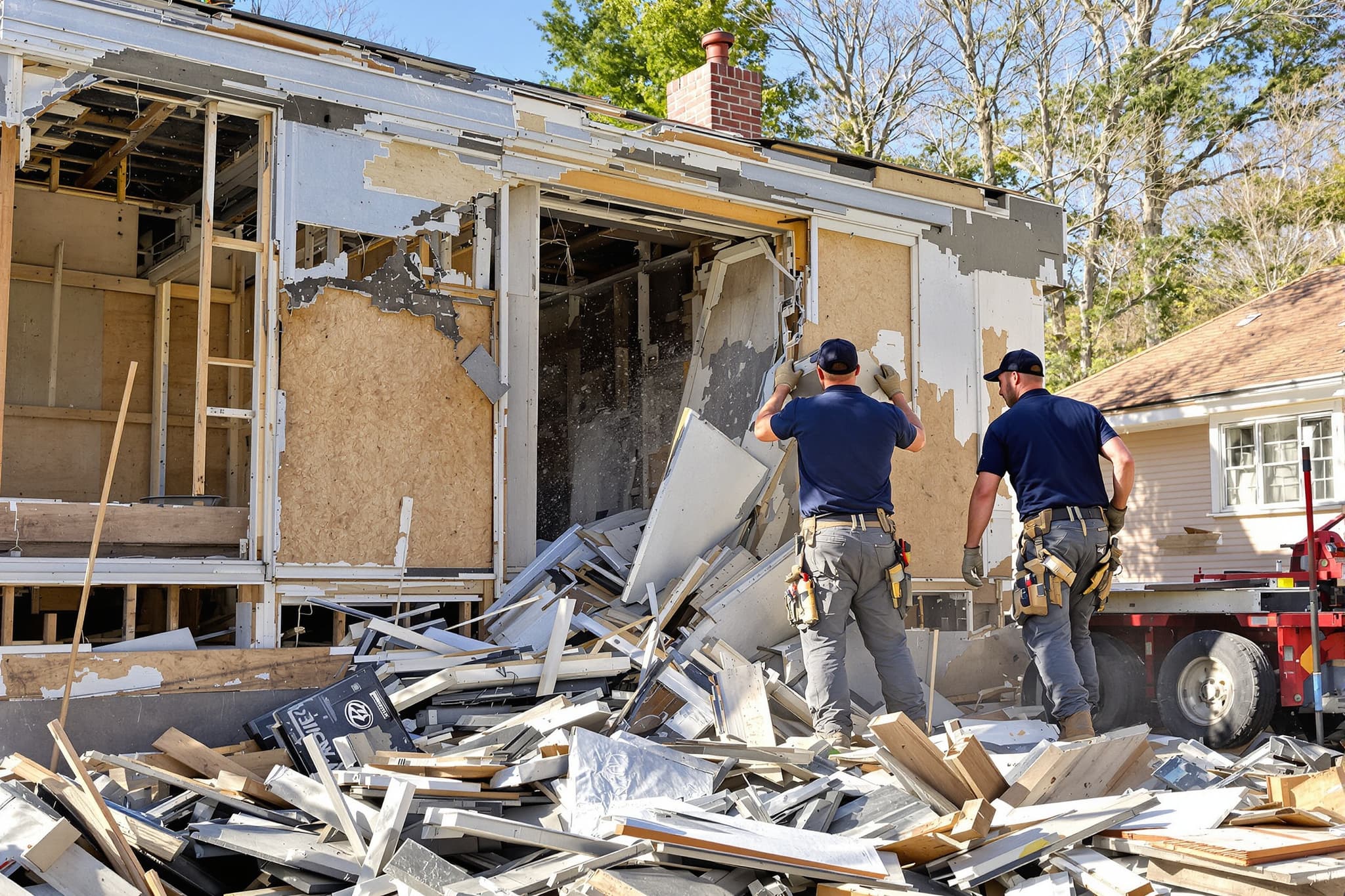
- Entire walls stripped bare. When 110+ mph gusts hit houses with old, loose vinyl, we see whole elevations stripped down to the house wrap.
- Missing corner posts. The vertical corner pieces pop out and disappear.
- Window trim failure. The J-channel around windows tears off, and the window itself is often compromised behind it.
- Sheathing exposed to rain. This is the emergency. If sheathing is exposed and it keeps raining, the wall cavity absorbs water and you start growing mold within 48 hours.
- Tree impact damage. Big trees coming down on houses cause structural damage that is a whole different problem from siding damage. We work alongside general contractors on these jobs.
Summer storm damage (June through August)
Localized thunderstorms are usually less destructive but still common. Isolated tree limbs, hail (rare on LI but it happens), and microbursts.
What Happens in the First 24 Hours After Storm Damage
Step 1: Stay safe and get photos. Do not go up on the roof. Do not try to tarp the damage yourself. Take photos from ground level as soon as it is safe. More photos is better. Get wide shots and close-ups.
Step 2: Call your insurance company. File the claim before calling us. Insurance companies want you to call them first so they can assign a claim number. Write down the claim number.
Step 3: Call us or text us photos. (516) 555-0100. Tell us your town and your name. We will tell you when we can be there. During normal conditions that is same-day for Nassau, next-day for Suffolk. During a multi-day storm event that hits the whole Island (named hurricanes), it may take 2-5 days because we are triaging by severity and we help the worst cases first.
Step 4: Emergency board-up. If sheathing is exposed and rain is in the forecast, the priority is getting the wall covered fast. We carry heavy-duty tarps, 1x4 strapping, and a nail gun specifically for emergency board-up. The goal is a weather-tight cover within 3 hours of arrival. Cost: flat $275 within Nassau, $350 within Suffolk, waived if you hire us for the full repair.
Step 5: Damage assessment and insurance coordination. After the wall is covered, we walk the house with you and document everything in the format your adjuster needs. If you give us permission, we will send the estimate directly to the adjuster and handle the back-and-forth.
Step 6: Repair. Once the claim is approved and materials are in hand, we schedule the actual repair. Simple repairs take 1-3 days. Full wall reconstructions take 5-10 days.
How We Work With Your Insurance Adjuster
Storm damage claims are almost always covered by standard homeowners policies. The claim process is easier when you have a contractor who speaks the adjuster's language. Here is what we do:
We provide Xactimate-compatible estimates. Xactimate is the software almost every insurance adjuster uses. Estimates submitted in that format are processed faster. We have a licensed Xactimate user on staff (Ryan).
We photograph and document everything. Not just the damage you can see, but the wall assembly behind it after we pull off the damaged material. Hidden damage (rotted sheathing, wet insulation) is often covered if it was caused by the same storm event.
We meet the adjuster on site. If the adjuster wants to see the damage in person, we schedule our walk-through for the same time. This cuts weeks off the approval cycle.
We negotiate fairly. Sometimes the adjuster's initial estimate undervalues the work. We will push back with a supporting explanation, but we will not inflate the claim. Insurance fraud is a felony and it ruins contractors. We do honest assessments.
We wait for approval before starting. We do not start the work until the claim is approved and you have the funds (or the funds are scheduled to release). This protects you from surprise out-of-pocket costs.
We bill the insurance directly (if allowed). Most carriers will let us bill directly once the claim is approved. You sign an Assignment of Benefits form (we will explain it) and the check goes to us. You do not write us a personal check and wait for the insurance to reimburse you.
What we do not do:
- We do not pay your deductible for you (that is insurance fraud)
- We do not "waive" deductibles with free upgrades (also fraud)
- We do not tell you to claim damage that was not caused by the storm
- We do not provide "storm damage free inspections" as a way to upsell unrelated work
See more → `/services/insurance-claims/`
What We Do During and After a Named Storm
When a named hurricane or major nor'easter is forecast to hit LI, we go into a specific protocol.
72-96 hours before landfall:
- We pre-stage tarps, strapping, and plywood at the Hicksville shop
- We contact customers mid-project and help them secure active jobsites
- We leave voicemail options open for emergency calls
During the storm:
- We are not driving to jobsites in 50+ mph winds. Nobody is.
- Leave a voicemail with your address and the damage if you can see it. We will get to you in the order of severity as soon as conditions allow.
- Do not call 911 unless there is a life safety issue. Call 311 for downed trees blocking roads.
First 24 hours after the storm:
- We triage calls starting at dawn
- Worst damage first (exposed sheathing with continuing rain = top priority)
- Emergency board-ups happen in the first 48 hours across all of Nassau and Suffolk
- We expand crew hours to 7am-8pm with two-crew rotations
Day 3-14 after the storm:
- Full damage assessments for everyone on the list
- Insurance documentation for claims
- Repair scheduling in the order claims are approved
- Larger jobs (full wall reconstructions) scheduled into week 3-5
When we started this business after Sandy in 2012 we had two guys and a cousin's borrowed truck. By week three of that cleanup we were working 14-hour days and had a waiting list. We learned every lesson a storm-cleanup crew can learn. We still run the same playbook.
Real Storm Damage Scenarios and What They Cost
| Scenario | Typical Cost Range | |---|---| | Emergency tarp and board-up (no repair yet) | $275 - $450 | | 4-10 vinyl panels replaced, no sheathing damage | $425 - $1,100 | | Full wall section (20-40 panels) + minor sheathing | $2,200 - $4,800 | | Entire elevation stripped and rebuilt | $6,500 - $14,000 | | Tree impact: structural damage + siding | $8,000 - $28,000 (may need general contractor) | | Full exterior reside after major storm | $18,500 - $62,000 (same as new install pricing) |
These numbers reflect the repair only. Most of the cost on significant storm damage is covered by insurance, minus your deductible. We can help you understand what your policy actually covers before the adjuster visit.